
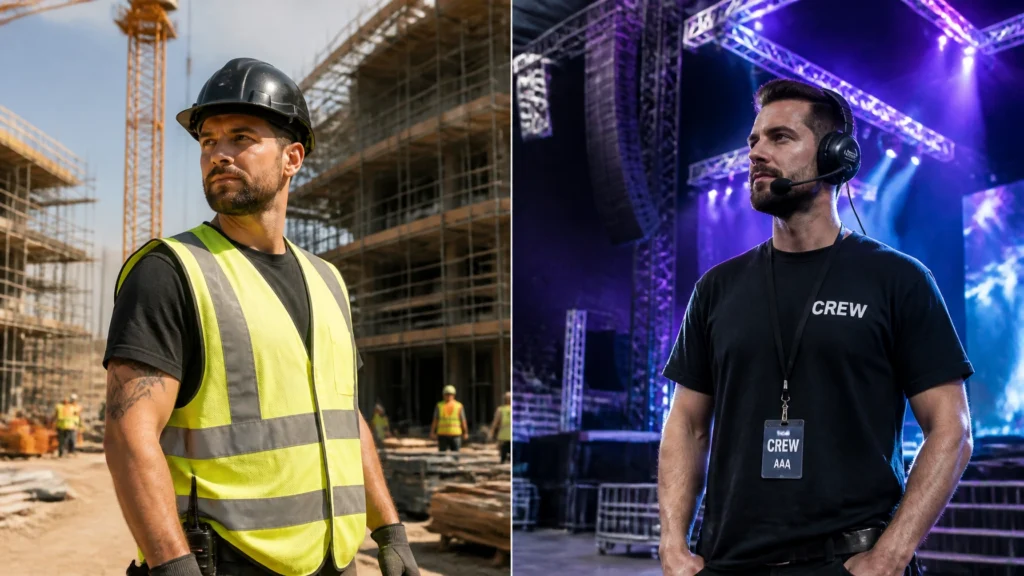
If you’re used to waking up at 5:00 AM, grabbing a coffee, and heading to a job site where you’ll be on your feet all day, you already have the "stamina" part of the equation figured out.
But for many laborers, there comes a point where the local construction site starts to feel a bit like a dead end. You’re working hard, but are you building a career or just a building?
There is another path that requires the same grit, the same calloused hands, and the same ability to follow a blueprint, but it takes place in stadiums and arenas instead of residential developments. It’s the world of concert production.
Let’s break down the real differences between construction labor and concert production to see which one is actually better for your long-term future.
The Reality of the Construction Grind
Construction is the ultimate "honest work." It’s predictable. You usually know exactly where you’re going, what time you’re starting, and what the paycheck looks like at the end of the week.
For many, this stability is the main draw. You have a routine. You can plan your life around a 7:00 AM to 3:30 PM schedule. If you get into a good union, the benefits and retirement plans are some of the best in the manual labor world.

However, construction has its downsides. It is incredibly hard on the body over decades. You’re often working in the elements: freezing winters and humid summers. There is also a "ceiling" for general laborers. Unless you specialize in a trade like electrical or plumbing, you can spend years doing the same heavy lifting without a significant jump in pay or responsibility.
The High-Energy World of Concert Production
Now, look at the live event industry. Every concert you’ve ever been to: from the local club to the Super Bowl halftime show: was built by people who used to be just like you.
Concert production is about "load-ins" and "load-outs." It involves building massive stages, rigging heavy lights from the ceiling, and running miles of cable to power the sound system. It is still manual labor, but the environment is completely different.
In live events, the "job site" changes. One week you might be at a local theater; the next, you could be on a tour bus heading to three different states. It’s fast-paced, high-stakes, and frankly, a lot more exciting than pouring concrete.
The Trade-Off: Schedule and Intensity
The biggest shock for people moving from construction to concerts is the schedule. In construction, you work when the sun is up. In concerts, you work when the show needs to happen. This means 16-hour days, late nights, and working on weekends.
If you value a "9-to-5" lifestyle, concert production might not be for you. But if you hate the idea of being stuck in the same town doing the same task every day, the variety of the live event world is a massive upgrade.
The Skills That Bridge the Gap
The good news is that if you have construction experience, you are already 70% of the way to being a high-level stagehand or production tech. The "labor" skills are the same; only the "tools" change.

Here are the skills you already have that the concert world is desperate for:
- Rigging and Safety: If you know how to secure a load on a crane or work safely at heights on scaffolding, you can learn to be a concert rigger. Riggers are some of the highest-paid people on a show crew.
- Power Tool Proficiency: Whether you're building a deck or a drum riser, a drill is a drill. The ability to use tools quickly and safely is a core requirement for "set carpenters" in the event world.
- Physical Stamina: Moving "road cases" (the heavy boxes that hold gear) is just like moving materials on a job site. You already have the muscle for it.
- Reading Blueprints: In construction, you read floor plans. In production, we read "plots": lighting plots, stage plots, and audio signal flows. The logic is exactly the same.
The Money Talk: Comparing Paychecks
Let’s talk numbers.
In the U.S., a general construction laborer makes a median salary of about $45,300 per year. If you’re in a specialized niche, you might hit the $60k or $70k mark after many years of experience.
In concert production, entry-level stagehands often start in a similar range, around $35,000 to $45,000. However, the "ceiling" in production is much higher and the path to get there is often faster.
Once you move from "general labor" to a specialized role: like an Audio Engineer, a Lighting Director, or a Production Manager: salaries often jump to $70,000 to $100,000+. On major tours, senior production roles can make significantly more than that because you aren't just paid for your labor; you're paid for your expertise.
The Lifestyle: Touring vs. Trestles
The biggest difference between these two paths is the lifestyle.
Construction is Local. You see your family every night. You sleep in your own bed. Your social circle is usually tied to your town.
Concert Production is Global. If you get on a tour, you are living on a bus. You wake up in a new city every morning. You work with a "road family" of 20 to 50 people who become your closest friends. For someone in their 20s or 30s who wants to see the world without paying for it, there is no better career.

Which Is Better For Your Future?
If you want a stable, predictable life where you can master a craft over 40 years and retire with a solid pension, Construction is a fantastic choice. It is the backbone of our world for a reason.
But if you feel like your potential is being wasted on a dusty job site, and you want a career that offers more excitement, travel, and a higher income ceiling, Concert Production is the clear winner.
The live event industry is a $1.3 trillion global market. It supports over 10 million jobs. And right now, it is starving for people who aren't afraid of hard work. The industry doesn't need more "influencers": it needs more people who know how to handle a wrench, solve a problem under pressure, and get the job done before the curtain goes up.
How to Make the Switch with "Get"
You don't just walk onto a Metallica tour and ask for a job. You need a roadmap.
At Get, we specialize in helping laborers turn their hands-on experience into a professional career in live events. We know you already have the work ethic; we just help you translate it.

We provide:
- A Career Roadmap: Visualizing your path from general laborer to a specialized tour professional.
- Interactive Tools: Helping you understand the different departments like Audio, Lighting, Video, and Rigging.
- 1-on-1 Mentoring: Connecting you with people who have already made the jump and can show you how to get your first gig.
The skills you learned on the construction site aren't "just" labor skills: they are the foundation of a high-paying, high-energy career in entertainment. You’ve done the hard part by building the stamina. Now, let’s use it to build something that people will actually cheer for.
Stop building houses you’ll never live in. Start building shows the world will never forget.