
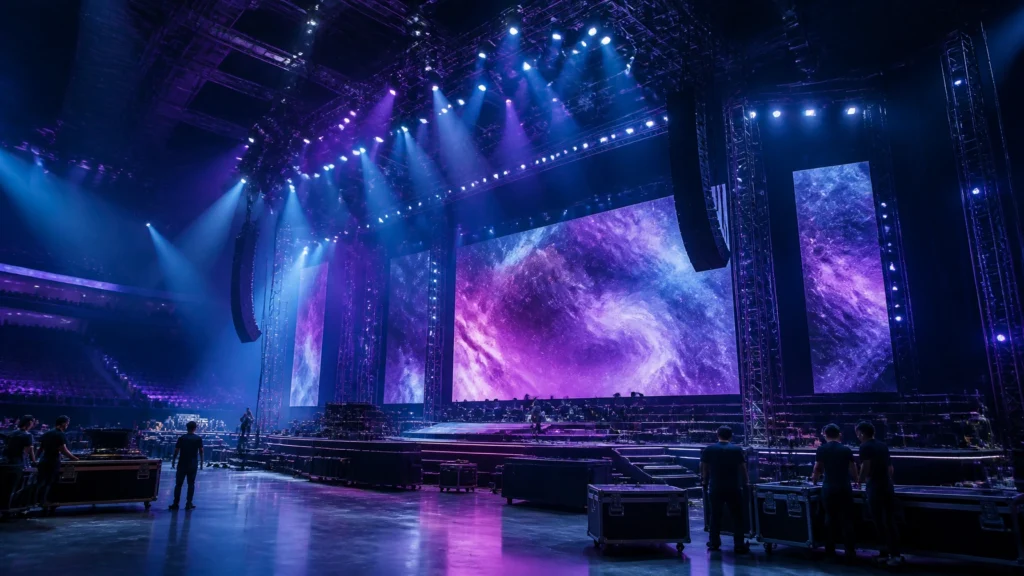
If you have spent your days on construction sites, in warehouses, or doing heavy labor, you already have something most people don’t: grit. You know how to show up early, work hard, and solve problems on the fly.
But maybe you're tired of the same old grind. You want a career that’s more exciting, more creative, and lets you be part of something big: like a massive music festival or a high-stakes corporate event.
That is where Audio Visual (AV) careers come in.
Transitioning from general labor to the live event industry isn’t as hard as you might think. In fact, the skills you already have are exactly what production companies are looking for. This guide will show you everything you need to know to make the jump and succeed in the world of AV.
What Exactly is an Audio Visual Career?
Audio Visual is a broad term. At its simplest, it’s about the technology that allows people to see and hear things at an event. This includes everything from the massive sound systems at a stadium concert to the projectors and microphones in a hotel ballroom.
As an AV professional, you aren't just "the guy with the wires." You are the engine that makes the show happen. Without you, the speakers stay silent, and the screens stay dark.
The Different Worlds of AV
When you start your career, you’ll find yourself working in one of these main areas:
- Live Music & Festivals: This is the high-energy side. You’ll be setting up stages, hanging speakers (line arrays), and running cables for the world's biggest artists.
- Corporate Events: Think conferences, product launches, and gala dinners. It’s cleaner work, often in nice hotels, and requires a high level of professionalism.
- Systems Integration: This is more like construction. You are installing permanent AV gear in offices, schools, or stadiums.
- Broadcast & Streaming: Helping produce live TV or internet streams for sports and news.

Why Your Labor Experience is Your Secret Weapon
A lot of people think they need a fancy college degree to get into AV. They’re wrong.
While some technical knowledge is required, most production managers would rather hire a reliable laborer who knows how to use a drill than a tech whiz who has never seen a hard hat.
Skills You Already Have:
- Physical Stamina: AV gear is heavy. If you’re used to hauling lumber or moving boxes, you’re already ahead of the pack.
- Safety Mindset: You understand the importance of PPE and site safety. In AV, where we hang heavy gear over people's heads, safety is everything.
- Tool Proficiency: You know your way around a toolkit. Knowing how to use a wrench, a screwdriver, and a multi-meter is essential.
- Working Under Pressure: When a show starts in ten minutes and a cable fails, you need to stay calm. Laborers are used to high-pressure environments.
At Get, we focus on taking that raw experience and layering on the specific technical training you need to become a pro.

Core Skills You Need to Learn
To succeed in AV, you need to speak the language. You don’t need to be an expert on day one, but you should understand the basics of the "Big Three": Audio, Video, and Lighting.
1. Audio Basics
Everything starts with signal flow. You need to understand how sound gets from a microphone, through a cable, into a mixer, and finally out of the speakers.
- Gear to know: Microphones (dynamic vs. condenser), XLR cables, and digital mixing consoles.
- Key skill: Learning how to wrap cables properly. If you "elbow wrap" a cable in this industry, you won't last long. Learn the "over-under" technique.
2. Video Basics
Video is about more than just plugging in a TV. You’ll be working with massive LED walls and high-powered projectors.
- Gear to know: HDMI, SDI, and Fiber optic cables. You'll also learn about switchers and media servers.
- Key skill: Understanding aspect ratios and resolutions (like 16:9 vs 4:3).
3. Lighting Basics
Lighting sets the mood. It can be as simple as a few "uplights" against a wall or as complex as a synchronized light show.
- Gear to know: DMX cables, LED fixtures, and moving heads.
- Key skill: Basic electrical safety. You’ll be dealing with a lot of power, so knowing how to handle it safely is a must.

Common Entry-Level Roles
You won't be mixing the sound for Coachella on your first day. You have to pay your dues. Here are the roles where most people start:
- Stagehand: This is the best way to get your foot in the door. You help unload trucks, push boxes, and run cables. It’s pure labor, but you get to watch the pros work.
- AV Technician (L1/L2): Once you know the gear, you move up to a technician role. You’ll be responsible for setting up specific areas, like the "breakout rooms" at a corporate event.
- Installation Assistant: If you like the construction side, you’ll work with a lead installer to mount screens and pull wire through ceilings and walls.
Career Growth: Where Can You Go?
The beauty of the AV world is that there is no ceiling. With a few years of experience, you can move into specialized roles that pay significantly more:
- FOH (Front of House) Engineer: The person mixing the sound for the audience.
- Lighting Designer: The person who creates the visual look of the show.
- Video Engineer: Manages the complex routing of video signals for huge screens.
- Project Manager: Oversees the entire production from start to finish.

How to Get Started: A 5-Step Plan
If you’re ready to trade your tool belt for a headset, follow these steps:
1. Master the "Over-Under"
Go on YouTube and search for "How to wrap AV cables over-under." Buy a 25ft XLR cable and practice until you can do it with your eyes closed. It sounds small, but it’s the universal sign of a professional.
2. Update Your Resume
Don't just list "Construction Worker." Highlight the skills that matter to AV. Use words like "Equipment Maintenance," "On-site Safety," "Team Collaboration," and "Problem Solving."
3. Get Basic Certifications
You don't need a degree, but a few certs can help. Look into:
- OSHA 10: Shows you know how to work safely on a job site.
- Dante Level 1: A free online certification for digital audio networking.
- CTS (Certified Technology Specialist): This is the gold standard, but you usually get this after you have some experience.
4. Find Local Production Houses
Search for "Event Production Companies" or "AV Rental Houses" in your city. Call them up and ask if they are looking for stagehands or shop techs. Many companies are desperate for reliable people who aren't afraid of hard work.
5. Join a Training Program
Self-teaching is great, but it can be slow. A structured program like what we offer at Get can fast-track your career. We help you bridge the gap between your current experience and the specific needs of the live event industry.
The Reality of the Job
Before you jump in, you should know what the lifestyle is really like.
The Pros:
- You get to see cool shows for free.
- Every day is different. One day you’re in a stadium, the next you’re in a high-end hotel.
- The community is tight-knit. You’ll make friends for life.
- The pay scales quickly as you gain skills.
The Cons:
- The hours are long. 12 to 14-hour days are common.
- The schedule is weird. You’ll work nights, weekends, and holidays.
- It’s physically demanding. You’ll be on your feet all day.
Final Thoughts
The world of Audio Visual is waiting for people like you. If you have the work ethic of a laborer and the curiosity to learn new tech, you can build a career that is both financially rewarding and incredibly exciting.
Stop just "working" and start building a career in the events you love. Your experience in labor isn't a distraction: it's your foundation. Now, it's time to build something better.
Ready to make the move? Check out how we can help you at Get.