
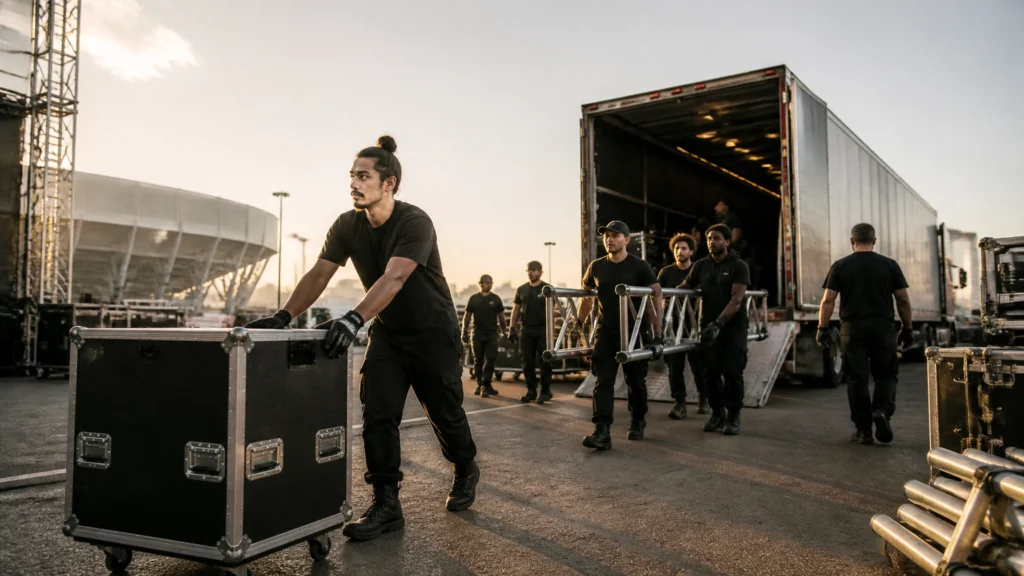
If you’ve done construction, warehouse, moving, or any kind of hands-on labor, you already have a head start on how to become a stagehand.
Live events need people who can show up on time, work hard, stay safe, and move gear fast. That’s it. This guide breaks down the simplest path into live event production jobs, what you’ll actually do on day one, what you’ll get paid (general ranges), and how to avoid the mistakes that get people cut from the call list.
What a stagehand really does (in plain English)
Stagehands are the crew behind concerts, theater, festivals, and corporate events. Depending on the gig, you might:
- Load and unload trucks
- Push road cases (big rolling boxes)
- Build stage decks and risers
- Run and tape cables
- Hang lights, speakers, LED wall pieces (when trained)
- Do “strike” (tear-down) and load-out after the show
A lot of entry-level work is basically material handling, but with tighter timelines and more teamwork than most job sites. (And yes, a lot of it happens at night.)
If you want a deeper overview, this guide from eMastered is a solid outside read:
https://emastered.com/blog/how-to-become-a-stagehand
Typical pay ranges (general)
Pay depends on your city, the venue, union vs. non-union, time of day, and the type of show. These are general U.S. ranges (not a promise):
- Entry-level non-union stagehand / event labor: $15–$25/hr
- Union stagehand (often IATSE), many markets: $25–$50+/hr
(Overtime and premiums can apply: especially for rigging, loaders, etc.)
If you want union context, start at IATSE and find your local directory:
https://iatse.net/
(They also have a “Join” page to understand how the process works: https://iatse.net/join/)
Quick-start checklist (do this before you overthink it)
- Make a short “stagehand” resume (your labor experience counts)
- Find 3 places to get calls: staffing companies + venues + union overhire list
- Buy/bring basic gear: boots, gloves, headlamp, wrench
- Learn the basics: call time, check-in, safety, cable handling
- Do 3 gigs without being late, unsafe, or hard to work with
That’s enough to start getting repeat calls.
Step 1) Translate your labor experience into stagehand language
This is where most people get stuck. They think they need “concert experience.” You don’t. You need to describe what you’ve already done in a way production folks recognize.
On your resume or when you introduce yourself, use phrases like:
- Material handling: loading/unloading, moving heavy items safely, using dollies/pallet jacks
- Jobsite safety: PPE, situational awareness, following a lead’s instructions
- Team pace: working in crews, hitting deadlines, staying productive under pressure
- Tools: basic hand tools, tape measure, wrenches, ladders (if true)
If you’ve worked nights, long shifts, or irregular schedules: say that. Live events love reliability more than flashy titles.
Step 2) Get on the right call lists (this is how you get paid)
Stagehand work runs on calls. No call list = no work.
Here are the main doors into concert production jobs, event technician jobs, and other live entertainment jobs:
Option A: Event labor / production staffing companies (fastest start)
Search your area for:
- “event labor staffing”
- “stagehand staffing”
- “AV labor”
- “production crew staffing”
These companies often staff:
- concerts
- trade shows
- hotel ballroom corporate events
- festivals
- convention centers
You’ll likely start as general labor (push cases, build deck, cable runs). That’s fine: your goal is consistent calls.
Option B: Local venues + AV companies
Reach out to:
- arenas
- performing arts centers
- convention centers
- production/AV companies
Ask: “Who staffs your stagehands? Can I get on the labor list?”
Option C: Union overhire (IATSE)
In many cities, you can start as a casual/overhire worker before becoming a member. Find your local through IATSE:
https://iatse.net/
If you go this route, take expectations seriously. Here’s a great “stagehand basics” page from IATSE Local 470 that lays it out clearly (call time, tools, safety, professionalism):
https://www.ia470.com/education/basics/stagebasics.html
Step 3) Learn the day-one rules (this keeps you getting called back)
You don’t need to know everything. You do need to know the rules that crews expect you to follow.
Key basics from IATSE Local 470’s guide:
- Be early: you’re expected on-site at least 10 minutes before call time, ready to work at call time: not walking in at call time.
Source: https://www.ia470.com/education/basics/stagebasics.html - Check in/out: find the steward/crew chief and make sure you’re on the list. Do the same when you leave.
Source: https://www.ia470.com/education/basics/stagebasics.html - Phone away: you’re there to work.
- Safety first: if you don’t understand a task or it feels unsafe, ask. Don’t guess.
This is also where you start picking a direction: audio, lighting, video, carpentry, or (later) rigging. But early on, your job is simple: be useful and don’t create problems.

Step 4) Show up prepared (what to bring on day 1)
This is the easiest way to stand out immediately.
What to wear
- Sturdy work pants (dark is best)
- Plain dark shirt/hoodie (no offensive graphics)
- Work boots (some calls require hard-toe; always avoid sneakers)
- Layers (you might bounce between dock and cold arena floor)
IATSE Local 470’s clothing section is blunt and accurate: you’re hired for heavy/dirty work and dark clothing matters when you’re visible.
https://www.ia470.com/education/basics/stagebasics.html#CLO
What to bring (simple “stagehand starter kit”)
- Work gloves (real ones, not thin fashion gloves)
- Headlamp or flashlight (you’ll work in the dark)
- 8” adjustable wrench + tether/lanyard (very common requirement)
- Sharpie + small notepad
- Water + snack (breaks can be weird)
IATSE Local 470 even lists required and recommended tools (including the wrench and gloves):
https://www.ia470.com/education/basics/stagebasics.html#TOOL

Step 5) Level up from “general hand” to better-paying gigs
Once you’re getting calls, you can start aiming for higher-skill roles (and better pay):
- Audio: cable runs, mic stands, patching basics, troubleshooting
- Lighting: hanging fixtures, focusing, data/power runs
- Video: LED panels, projectors, signal runs
- Carpentry: staging, platforms, soft goods, set pieces
- Rigging (advanced): motors, points, overhead systems (safety-critical)
This is how people move toward touring crew jobs and steadier careers in live event production jobs. It’s not magic: it’s reps, training, and reputation.
A clean way to think about it:
- Get on calls
- Be reliable
- Add one skill at a time
- Become “the person they request”

Common mistakes that get you cut (avoid these)
If you avoid these, you’re already ahead.
- Showing up at call time (instead of early)
Crews remember lateness. And some hiring halls will move you down the list. - Being unsafe to “look tough”
Live events are not the place for ego. Safety is the job. - Bringing the wrong attitude
Complaining, arguing, ignoring direction, or acting like you’re above pushing cases = no callbacks. - Not having basic PPE/tools
No gloves, no light, no boots, no wrench: makes you a liability. - Not understanding you’re paid for speed + precision
This isn’t “slow and steady.” You move with the team and follow the system.
For a straight talk expectations list, again:
https://www.ia470.com/education/basics/stagebasics.html
Where Get fits in (turn labor experience into a live event career)
A lot of laborers can do the work: they just don’t know the path in.
That’s what Get does: we help you turn your existing labor background into a real lane in live events, including:
- How to position your experience so you actually get called
- What entry roles to target (and which ones to skip)
- What to learn first so you can move up faster
- How to build a reputation people request (the real currency in this industry)
If you can show up, work hard, and learn, you can build a career in live entertainment jobs without starting from zero.
Brand note: Get logo asset (for site use): https://cdn.marblism.com/jTcQ9Ip8yxU.png

One-page recap: 5 steps to become a stagehand and get paid
- Translate your labor experience into stagehand terms (material handling, safety, crews).
- Get on call lists (staffing companies, venues/AV shops, IATSE overhire).
- Learn day-one rules (early, check in, safety, phone away).
- Show up prepared (boots, gloves, light, wrench, water).
- Level up one skill at a time (audio/lighting/video/carpentry → touring opportunities).
If you want, tell me your city + what kind of labor work you’ve done (construction, warehouse, moving, etc.) and I’ll suggest the fastest “first calls” path and which direction (audio/lighting/video) is usually the best move.