
Let’s be real for a second.
You’re currently working a warehouse job. You’re fast, you’re strong, and you know how to move weight. You spend eight to twelve hours a day dodging forklifts, stacking pallets, and hitting quotas that feel like they were designed by a robot. You’ve got the grit. You’ve got the work ethic. But at the end of the day, what are you actually building? A bigger pile of cardboard?
What if you took that exact same physical effort: the pushing, the pulling, the loading, and the safety-first mindset: and applied it to something that actually has a heartbeat?
Welcome to the world of live event production jobs. Specifically, welcome to the life of a stagehand.
If you’ve ever wondered how to become a stagehand, you’re in the right place. You don’t need a degree in "Rock n' Roll." You need the skills you already have, a little bit of specialized knowledge, and the willingness to trade the warehouse floor for the arena deck.
The $1.3 Trillion Industry You Didn't Know Existed
Before we dive into the "how," let’s talk about the "why."
Most people think of "the show" as just the two hours the band is on stage. They don't see the army of people that makes it happen. According to recent industry data, the global events industry is a staggering $1.3 trillion powerhouse. We’re talking about everything from Taylor Swift stadium tours and Coachella to massive corporate summits and trade shows.
This isn't a hobby. It’s a massive economic engine that is constantly hungry for reliable, hardworking labor. While retail and traditional manufacturing might be shifting toward automation, you can’t automate the process of flying a three-ton lighting rig in a muddy field in the middle of July.
That’s where you come in.

What is a Stagehand, Really?
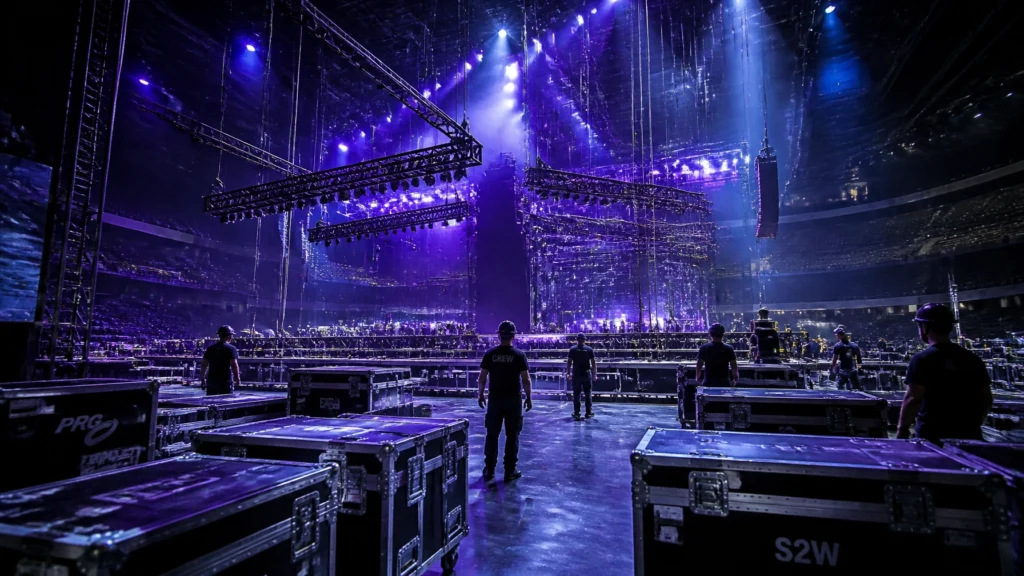
In the simplest terms, a stagehand is the muscle and the backbone of a live production. You are the person who turns an empty concrete room or a grassy park into a world-class entertainment venue.
When you start looking for live event production jobs, your first title will likely be "General Stagehand" or "Loader." Your day-to-day tasks will look surprisingly familiar:
- Loading/Unloading Trucks: Moving gear from the semi-truck to the stage.
- Case Pushing: Navigating heavy road cases (the ones with the wheels) to their designated spots.
- Setting the Deck: Building the actual stage platforms and risers.
- Cabling: Running power and signal lines (we call this "looming") across the floor.
- Support: Helping the "Specialists" (Audio, Lighting, Video, and Rigging techs) get their gear in the air.
Why Your Warehouse Skills are Your Secret Weapon
Here is the secret nobody tells you: If you can thrive in a high-volume warehouse, you can thrive on a concert load-in.
The transition is easier than you think because the core "grit" is identical. Here’s how your warehouse experience maps directly to stagehand training:
1. Pushing Cases vs. Pushing Pallets
You already know how to handle weight. In a warehouse, you might use a pallet jack. In production, we use road cases. Learning how to steer a 400-pound audio rack through a narrow backstage hallway is just like navigating a crowded warehouse aisle. You’ve already got the spatial awareness and the muscle memory.

2. Safety and Logistics
In the warehouse, a mistake can lead to a collapsed rack. In a venue, a mistake can lead to a truss falling. Your respect for safety protocols, OSHA standards, and looking out for your team is the most valuable asset you bring to the table. Stage managers don't want "cool" people; they want people who won't get themselves or anyone else hurt.
3. Physical Stamina
Stagehands work long hours. Load-ins can start at 6:00 AM, and load-outs might not finish until 2:00 AM the next day. If you’re used to being on your feet for a full shift in a distribution center, you already have the "iron legs" needed for this industry.
Stagehand Training: Learning the Lingo
While your grit gets you through the door, a little bit of stagehand training keeps you on the call list. You don’t need a six-month course, but you do need to know the basics so you don't look "green" on your first day.
- The "Stage Right" Rule: Everything is from the perspective of the performer. If you're standing on stage looking at the empty seats, "Stage Right" is your right.
- Upstage vs. Downstage: Upstage is toward the back wall; Downstage is toward the audience.
- The Tool Belt: You don't need a massive toolbox. Start with the "Stagehand Holy Trinity":
- A 6-inch or 8-inch Crescent Wrench (C-Wrench): For tightening bolts on lighting clamps.
- A Multi-tool: For… everything.
- Work Gloves: To protect your hands from those road case hinges.

How to Become a Stagehand: Your First 3 Steps
Ready to ditch the warehouse? Here is your roadmap to landing your first gig.
1. Find the Local Crewing Companies
Most live events don't hire individuals directly; they hire labor providers. Look for companies in your area like Rhino Staging or Crew One. These companies are almost always hiring "pushers" and entry-level hands. Apply with your warehouse resume: just make sure to highlight your physical labor and safety experience.
2. Check the Union (IATSE)
The International Alliance of Theatrical Stage Employees (IATSE) is the union that represents many stagehands in North America. Look up your local IATSE chapter. Many locals have an "Overhire" list where beginners can pick up work during busy seasons.
3. Dress the Part
The "Stagehand Uniform" is simple: all black. Black t-shirt (no logos), black work pants, and sturdy closed-toe shoes (steel toe is often preferred). If you show up in a bright red hoodie, you’re telling the Crew Chief you don’t know how the industry works. The goal is to be "invisible" so the focus stays on the show.
The Reality of the Gig
Is it all rock stars and VIP passes? Definitely not. It’s hard, sweaty work. It’s loud. It’s often dusty.
But here’s the difference: When the house lights go down, the crowd roars, and the first chord hits, you get to look up and say, "I built that." There is a level of pride in live events that you simply won't find in a fulfillment center. You aren't just moving boxes; you're moving people.

Take the Leap
The $1.3 trillion industry is waiting for people like you. If you have the warehouse grit, you already have 90% of what it takes. The other 10% is just showing up on time, bringing your C-wrench, and being ready to learn.
Keep an eye on this blog: we're going to keep breaking down exactly how to navigate this world. Your warehouse experience isn't just a job; it’s the training ground for your new career in the spotlight.
Ready to start? Stop looking at the pallets and start looking at the stage. Your first load-in is closer than you think.