
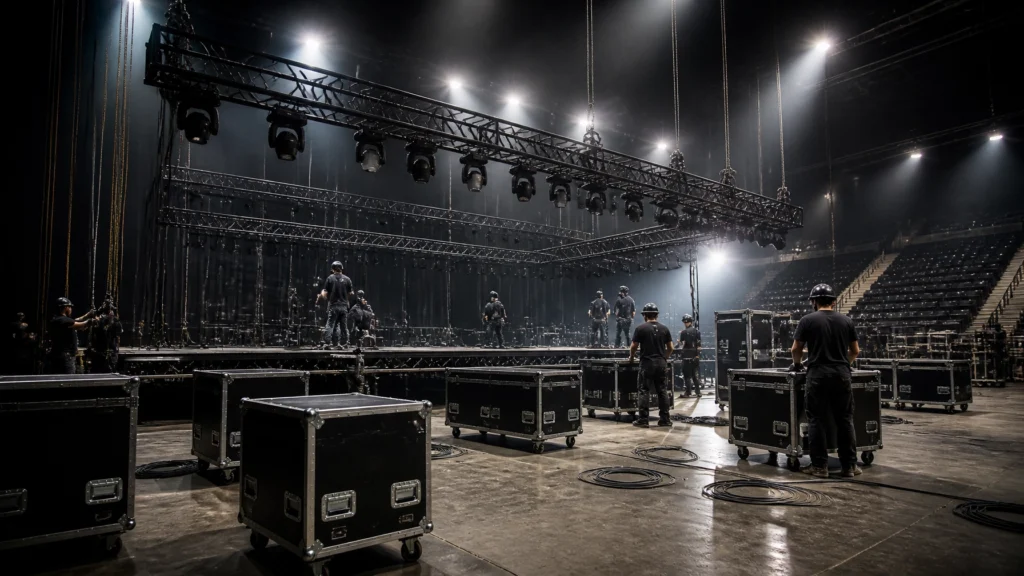
If you have spent your life doing manual labor, construction, warehouse work, or moving, you already have 90% of what it takes to work in live events. You know how to show up early. You know how to work hard. You know how to handle tools.
The concert industry isn’t looking for degrees. It’s looking for people who can move heavy things safely and follow directions under pressure.
Here are the five simple steps to get your foot in the door and start your career in concert production.
Step 1: Choose Your Entry-Level Role
You don't start as the guy mixing sound for 20,000 people. You start as the person who gets the gear off the truck and onto the stage. There are three main titles you should look for when you're starting out.
The Stagehand
A stagehand is the "everything" person. You help build the stage, hang the lights, and run the cables. If a technician needs a hand moving a drum riser, you’re there. It is the best way to see how every department works.
The Loader
Loaders have one main job: getting cases out of the semi-trucks and into the venue (and back again at the end of the night). It is pure muscle work. If you have done warehouse loading, this will be second nature to you.
The Runner
Runners are the logistics crew. You might be picking up a specific type of water for the band or driving a van to the airport. It requires a clean driving record and a good knowledge of your local area.

Step 2: Get the "Show Blacks" and Basic Gear
In the concert world, the dress code is simple: stay invisible. This means wearing "Show Blacks."
The Uniform
- Plain Black T-shirt: No logos, no graphics, no stripes.
- Black Work Pants: Sturdy cargo pants or jeans. Avoid shorts; they aren't safe on a busy stage.
- Closed-Toe Shoes: Steel-toe boots are preferred. You are moving heavy cases, and a crushed toe will end your career before it starts.
The Kit
You don't need a massive toolbox yet. A small backpack with these basics is enough:
- Work Gloves: Essential for protecting your hands from metal burrs and heavy lifting.
- Crescent Wrench (C-Wrench): The "master key" for most lighting and truss hardware.
- Multi-tool: For quick fixes.
- Flashlight: It gets dark backstage. A small, bright LED light is a lifesaver.

Step 3: Find the Gatekeepers
You won't find these jobs on the big corporate job boards most of the time. Concert work is built on "call lists." To get on a list, you need to find the people who manage them.
Local Labor Companies
Most cities have "labor providers" or "crew companies." These companies specialize in providing the muscle for big tours. Look for local companies in your area that provide "stagehand labor."
Production Houses
Companies that own the sound, lights, and video gear often need extra hands to prep gear in their warehouses or help with local setups. These are often called "AV houses" or "Production Companies."
Smaller Venues
Don't ignore the local theaters and mid-sized clubs. Walk in during the day (usually between 11 AM and 2 PM) and ask for the Technical Director or Production Manager. Keep it brief: "I'm a laborer looking to get into stagehand work. Do you have a crew list I can join?"

Step 4: Crush Your First Shift
Your first day on a crew is your audition. If you do well, you get called back. If you don't, you'll never hear from them again. Production managers value reliability over almost everything else.
Show Up Early
In this industry, "on time" is 15 minutes late. If call-time is 8:00 AM, you should be standing there with your gloves on at 7:45 AM.
Listen More, Talk Less
When you're on a busy stage, there is a lot of noise and movement. Listen to your Crew Chief. Do exactly what they say. If you don't understand an instruction, ask for clarification once, then do the job.
Learn the "Over-Under"
One of the fastest ways to prove you aren't a "newbie" is knowing how to coil a cable properly. Ask a senior tech to show you the "over-under" technique. It prevents cables from tangling and is a universal skill in live events.

Step 5: Turn One Gig into a Career
Once the show is over and the trucks are packed, your work isn't done. You need to make sure you get the next call.
The Follow-Up
At the end of the night, find the person who hired you. Thank them for the opportunity and ask, "Are there any other shows coming up that you need help with?"
Build Your Reputation
In the beginning, say yes to everything. The late-night load-outs, the 4 AM load-ins, and the dirty jobs. Being the person who doesn't complain when the work gets tough is the fastest way to the top of the call list.
Connect Sideways
Talk to the other stagehands. Most of them work for multiple companies. If you’re a hard worker, they will often recommend you to their other bosses. This "sideways networking" is how most professionals fill their calendars.
Conclusion
Transitioning from general labor to concert production is a smart move. The work is physically demanding, but the environment is exciting, and the career path is wide open. By following these five steps, you move from the sidelines into the heart of the show.
Get your gear ready, find your local venues, and show up. The stage is waiting.
References:
- Skillshot: How to Break into Live Production
- ThinkCybis: Getting Involved in the Live Event Industry
- OSHA: Safety for Stagehands and Event Labor