
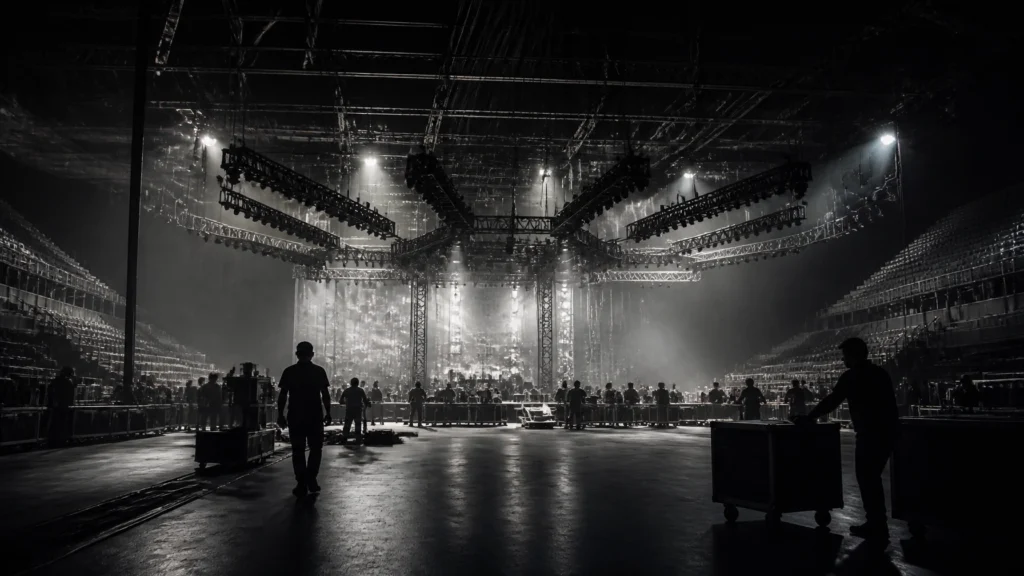
You see the massive LED walls at festivals. You hear the earth-shaking bass at stadium tours. You watch the complex light shows that seem to move in perfect sync with the music.
If you’re working a labor job right now: moving lumber, hauling concrete, or grinding out shifts on a construction site: you might look at those stages and think, "I could never do that." You assume there’s a wall of "experience" or a four-year degree standing between you and a career in live events.
Here is the truth: the audio-visual (AV) industry is built on the backs of people who started exactly where you are.
The industry doesn't need more people with degrees in "Music Theory." It needs people who know how to work. If you have hustle and a solid set of labor skills, you are already more qualified for an entry-level AV job than someone who spent four years in a classroom.
The Degree Myth
One of the biggest lies in the professional world is that you need a specialized degree to touch expensive gear. In the AV world, this couldn't be further from the truth.
While there are schools that teach audio engineering and film production, they often fail to teach the one thing that matters most on a job site: practical execution. A degree might tell you how sound waves travel through a room, but it doesn't teach you how to safely tip a 400-pound speaker rack off a truck ramp in the rain.
Most crew chiefs and production managers would rather hire a laborer who is reliable and knows how to use a wrench than a "tech genius" who thinks they are too good to push a box. According to industry data, many entry-level AV roles require no prior experience or advanced education: just a high school diploma and a willingness to learn on the job.

What "Experience" Actually Means to a Crew Chief
When you see a job posting that says "1-2 years of AV experience preferred," don't let it stop you. In this industry, "experience" is often code for three simple things:
- Reliability: Do you show up 15 minutes early? In live events, if you’re "on time," you’re late. If a show starts at 8:00 PM, the gear has to be ready. There is no "rescheduling" a concert because a technician didn't show up.
- Hustle: Can you move fast without being told every single step? Production schedules are tight. "Load-in" is a race against the clock. Crew chiefs want people who see a job that needs doing and do it.
- The Ability to Listen: You don't need to know where every cable goes on day one. You just need to be able to take a specific direction and execute it perfectly.
If you can prove you have those three traits, you have 90% of what a production company is looking for in a new hire.
The Laborer’s Edge
If you have a background in manual labor, you actually have a massive advantage over the "tech kids." You already understand the fundamentals of a job site. You know how to work with your hands, you’re comfortable with power tools, and you don't complain when the shift hits the 12-hour mark.
Live events are essentially a construction project that has to be built and torn down in a single day. The skills you use in labor: spatial awareness, physical stamina, and basic mechanical knowledge: transfer directly to setting up stages.
Moving a flight case is just material handling. Hanging a light is just rigging. Running cables is just cable management. The gear is different, but the work is the same.

The "Box Pusher" Path
Every legend in the AV industry started as a "Box Pusher." This is the entry-level stagehand role where your primary job is to unload the trucks and push cases to where the lead technicians need them.
Do not look down on this role. It is your foot in the door. It is the best "classroom" in the world.
While you are pushing boxes, you are watching how the stage is built. You are seeing how the cables are routed. You are learning the names of the gear. If you work hard and keep your eyes open, a lead tech will eventually ask you to help them with something more complex. That is how you "level up." You don't get promoted because of a resume; you get promoted because you were the most helpful person on the loading dock.

3 Skills You Can Learn Today (For Free)
You don't need a school to learn the basics of AV. If you want to show up to your first gig looking like a pro, focus on these three things:
- The Over-Under Cable Wrap: This is the "secret handshake" of the industry. If you know how to wrap a cable properly so it doesn't tangle (the over-under method), you immediately look like you know what you’re doing. You can learn this in ten minutes with a garden hose or an extension cord at home.
- Signal Flow: Learn the basic concept of "Input to Output." A microphone goes into a mixer, the mixer goes into an amplifier, and the amplifier goes into a speaker. Once you understand that simple chain, everything else is just a more complicated version of that.
- Safety Standards: Learn how to lift with your legs and wear the right gear. Steel-toe boots, black clothing (the "stagehand uniform"), and a good multi-tool are your basic requirements.
How to Get Your First Gig
If you’re ready to trade the construction site for the concert stage, you don't need to wait for a job opening at a major production house. Look for local labor brokers or "stagehand unions" in your city. These companies are always looking for extra hands for "load-ins" and "load-outs."
Tell them you have a background in labor, you’re reliable, and you’re willing to start at the bottom. The industry is currently facing a shortage of trained, reliable workers, which means companies are more willing than ever to train someone from scratch if they show the right attitude.

Stop Waiting, Start Pushing
The only thing stopping you from a career in live events is the belief that you aren't "technical" enough. Technology can be taught. Cables can be labeled. Software can be learned.
What can't be taught is the grit and work ethic you’ve already developed in your labor career.
The AV industry is waiting for people who aren't afraid to get their hands dirty. You already have the most important tools in your belt. It’s time to stop pushing lumber and start pushing the show forward.