
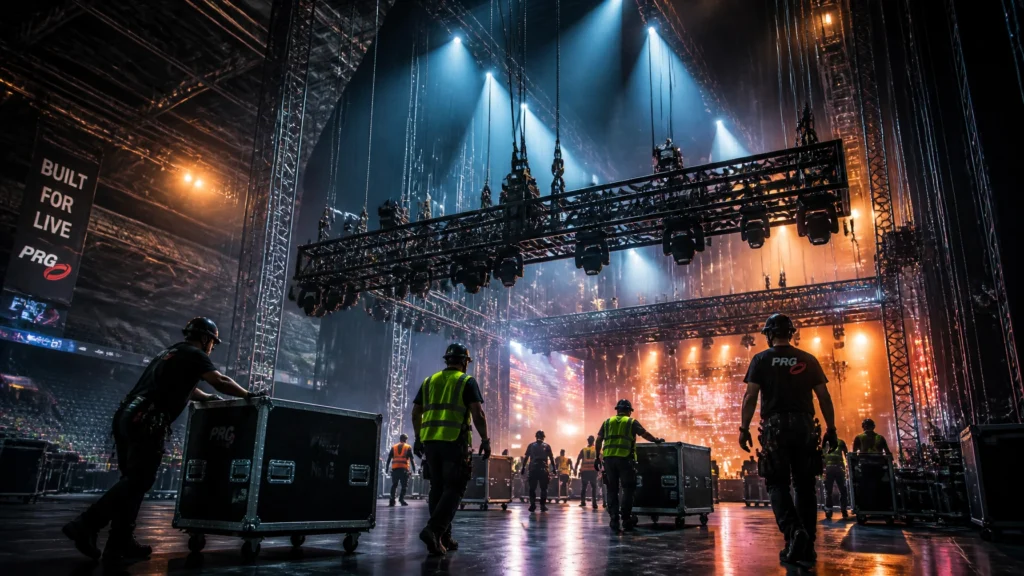
If you’ve spent any time working in a warehouse, you know the drill. The fluorescent lights, the repetitive motion of picking and packing, the feeling that you’re just a cog in a machine that never stops. You’ve got the work ethic, you’ve got the muscle, and you definitely know your way around a forklift. But let’s be honest: are you actually going anywhere, or are you just moving boxes from Point A to Point B until your shift ends?
What if I told you there’s an industry that desperately needs your exact skills, pays better, offers a way more exciting environment, and is currently worth over a trillion dollars?
I’m talking about the live event industry.
Most people see a concert, a massive trade show, or a high-end wedding and think about the music or the decorations. They don’t see the army of people behind the scenes who made it happen. But that "army" is where the real opportunity lies for people like you.
According to recent industry data, the global events market is projected to reach a staggering $1.34 trillion by 2025. This isn't just a "gig economy" side hustle anymore; it’s a professionalized, tech-driven global powerhouse that is starving for dependable, skilled labor.
If you’re tired of the warehouse grind, it’s time to look at the stage.
The Massive Scale of the "Show" Business
When we talk about live events, we aren't just talking about your favorite band coming to town. We’re talking about a massive ecosystem that includes corporate conferences, massive trade shows, music festivals, and high-end private events.
The numbers are honestly mind-blowing. In the United States alone:
- The independent live sector supports about 908,000 jobs and generates $153.1 billion in economic output (check out the NIVA State of Live report for the full breakdown).
- The wedding services industry is a $70.3 billion beast, employing over a million people.
- The global event management market is expected to climb to $1.76 trillion by 2029.

For a laborer, these numbers mean one thing: Stability.
While other industries are being automated or outsourced, you can’t "outsource" the crew needed to build a stage for a stadium tour or set up the lighting for a 5,000-person tech conference. The demand for people who can handle logistics, manage equipment, and work safely in high-pressure environments is at an all-time high.
Why Your Warehouse Skills are Your "Golden Ticket"
The biggest mistake I see laborers make is thinking they "don't have the experience" for live events. They think they need to be a sound engineer or a lighting designer to get a foot in the door.
That couldn't be further from the truth.
The reality is that about 80% of what makes a live event successful is logistics, material handling, and safety: things you are already doing every single day in the warehouse. Let’s map it out:
- Material Handling & Forklift Operation: In the warehouse, you move pallets. In live events, you move road cases, trusses, and delicate AV gear. A forklift certification is like gold in this industry. Arena load-ins and convention center setups rely on skilled operators to move millions of dollars of gear safely.
- Truck Packs & Space Optimization: Ever had to Tetris a trailer full of inventory? That is a core skill for a touring crew. Loading a production truck (a "truck pack") is an art form. If you can do it efficiently, you’re already ahead of the pack.
- Safety & Compliance: Warehouse workers understand PPE, fall protection, and the importance of following procedures. In the world of meeting and event planning, safety isn't just a suggestion: it's the law. Your disciplined approach to safety is exactly what production managers are looking for.
- Physical Stamina & Reliability: The live event world isn't a 9-to-5. It’s early mornings, late nights, and long shifts. You’re already used to being on your feet and putting in the work. That grit is something most "office people" just don't have.

From "Gigs" to a Professional Career
Twenty years ago, getting into "roadie" work was mostly about who you knew. It was informal, a bit wild, and definitely not seen as a "career path."
That has completely changed.
Today, the industry has moved toward professionalization. Shows are bigger and more complex than ever. We're talking about LED walls that are several stories high, automated lighting rigs, and complex digital audio networks. Because the technology has become so expensive and the stakes so high, companies are no longer looking for "helpers": they’re looking for technicians.
This shift is actually great news for you. It means there is a clear ladder to climb. You might start as a stagehand helping with a load-in, but with the right training, you can quickly move into specializing as a:
- Lighting Tech: Mastering the power and data cables that run the show.
- Video/LED Technician: Building the massive screens you see at festivals.
- Rigger: The high-stakes job of hanging equipment from the ceiling (huge pay, huge responsibility).
- Audio Assist (A2): Helping manage the wireless mics and stage monitors for artists.
The Bureau of Labor Statistics projects a 5% growth in event roles over the next decade. That’s about 15,500 new openings every single year. These aren't just one-off gigs; these are roles in a professionalized industry where "knowing your stuff" leads to high-paying, long-term careers.
The Diverse World of Events
When most people think of this career, they think of rock concerts. And while touring with a band is an incredible experience, it’s only one slice of the pie.
Check out the wedding and private event sector. In the U.S., weddings are a $70 billion industry. These aren't just backyard parties; we're talking about luxury events that require massive tents, complex sound systems, and intricate lighting designs. According to Zippia, the average wedding costs nearly $30,000, and a huge chunk of that goes toward the production and labor.
Then there are corporate events. Every time a big tech company launches a new phone or a pharmaceutical company has a national sales meeting, they hire production companies. These events are clean, professional, and usually happen during the week: offering a different kind of lifestyle than the "touring life."

Your Roadmap: How to Make the Switch
So, how do you actually get from the warehouse to the stadium? It doesn't happen overnight, but the path is clearer than you think.
1. Rebrand Your Experience
Stop telling people you "work in a warehouse." Start telling them you have "3 years of experience in high-volume material handling, logistics, and heavy equipment operation with a 100% safety record." You speak the language of production: you just need to translate your resume.
2. Learn the "Show" Language
You don't need a four-year degree, but you do need to know the difference between an XLR cable and a PowerCon. You need to know what a "truss" is and why you never walk under a load that’s being hoisted. There are tons of resources out there to learn the basics of stagecraft.
3. Get Your Certifications
If you have a forklift cert, keep it current. Look into getting an OSHA-10 or OSHA-30 certification. In the eyes of a production manager, a worker with an OSHA card and a forklift license is a "low-risk, high-value" hire.
4. Network in the Right Places
Look for "AV Labor" or "Stagehand Staffing" companies in your city. Reach out to local venues, convention centers, and theaters. The industry is fragmented, made up of thousands of small-to-medium businesses that are always looking for reliable crew.

The Bottom Line
The live event industry is a $1.3 trillion giant, and it is built on the backs of skilled, dependable laborers. If you’ve got the work ethic from the warehouse, you already have the most important ingredient for success.
Stop moving boxes that don’t matter. Start building experiences that people will remember for the rest of their lives. It’s a stable, growing, and incredibly rewarding career path: and the door is wide open for you to walk through it.
Are you ready to turn your labor experience into a live event career? Let's get to work.