
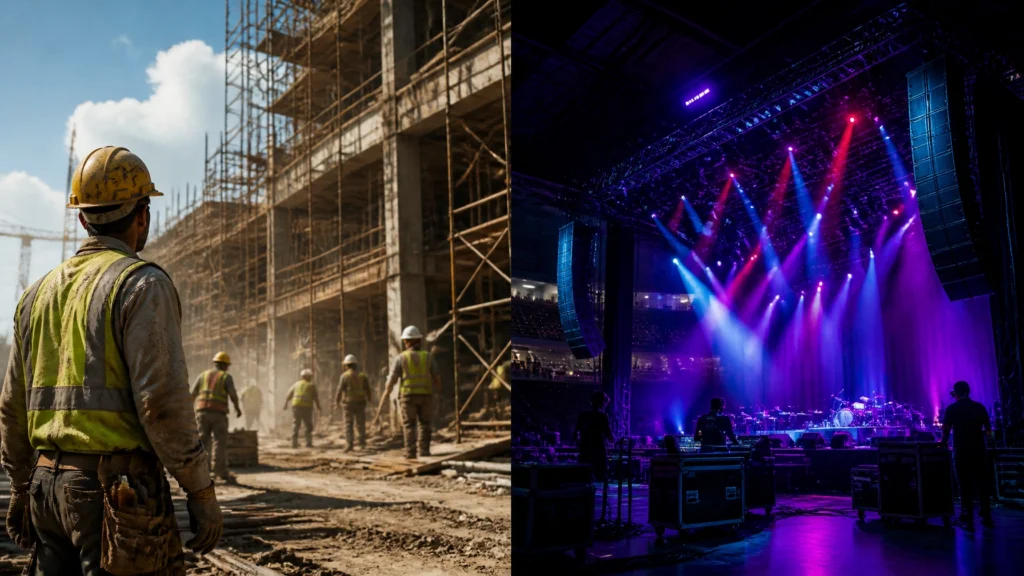
You know the feeling. It’s 6:00 AM, the air is cold, and you’re staring at a pile of rebar or a stack of drywall. You’ve been doing this for years. You’re good at it. You know how to work hard, you’re not afraid of a long day, and you know your way around a toolbox. But lately, you’ve been wondering if this is it. Is this the same view you’re going to have for the next twenty years?
For many laborers, construction is the default. It’s steady, it’s physical, and it pays the bills. But there’s another world out there that needs your exact skill set: and it’s a lot more exciting than a housing development.
Welcome to the world of touring crews and live events.
If you’ve ever wondered what happens behind the scenes of a massive concert, a world-class festival, or a massive corporate event, you’re looking at your next career move. Here is why trading the hard hat for a headset might be the best decision you ever make.
The Environment: From Dirt to Decibels
Construction is often a battle against the elements. You’re in the mud, the dust, and the pouring rain. While there’s a certain pride in building something from the ground up, the environment can be grueling.
In live events, the "site" is different every few days. One day you’re in a state-of-the-art arena in Los Angeles, the next you’re in a historic theater in Chicago. While you’ll still deal with outdoor festivals and the occasional rain delay, a huge portion of the work happens in controlled environments.
Instead of the sound of jackhammers, your workday is soundtracked by soundchecks. Instead of gray concrete, your office is filled with millions of dollars of high-tech lighting and video walls. It’s a sensory experience that construction just can’t match.

Travel: The Road vs. The Commute
In construction, your commute is usually the same drive every morning. You might move to a new site every few months, but you’re likely staying in the same general area.
Touring crew jobs turn your life into an adventure. When you join a tour, travel isn't an "extra": it’s the job. You live on a tour bus, waking up in a new city nearly every morning. According to industry insights, touring crew members can see more of the country in six months than most people see in a lifetime.

For a laborer who feels stuck in their hometown, this is a game-changer. You aren't just working; you're exploring. You’re getting paid to see the world, and your "hotel" travels with you. While the bus life isn't for everyone, for those who love the road, there is nothing else like it.
Physical Work: Sprinting vs. Marathoning
Make no mistake: live events are hard work. If you’re a laborer, you already have the physical foundation needed. However, the type of work is different.
Construction is often a marathon. It’s a steady, eight-to-ten-hour grind of consistent physical output. Live events are more like a series of sprints.
The "load-in" is an intense burst of energy where the crew transforms an empty room into a massive production in a matter of hours. You’re pushing road cases, flying truss, and running miles of cable. Then, during the show, things often move into a "standby" or "show-op" mode where the pace settles down. Once the lights go out and the crowd leaves, the "load-out" begins: another high-speed sprint to get everything back in the trucks.
If you enjoy the "all hands on deck" intensity of a big push, you’ll love the rhythm of a live event. It’s fast-paced, high-stakes, and incredibly satisfying when that first note hits and the lights go up.

The Skills: You Already Have 80% of What You Need
The biggest myth about the live event industry is that you need a degree in "Stagecraft" to get started. The truth? If you can read a tape measure, use a drill, and follow a blueprint, you’re already ahead of the game.
The rigging in a concert venue isn't that different from the structural steel in a building. The electrical runs for a stage aren't that different from wiring a commercial space. The attention to detail and safety protocols you learned on a job site are exactly what touring managers are looking for.
You have the "work muscle." You know how to show up on time and stay until the job is done. The technical stuff: the specific types of lights, the audio consoles, the video processing: can be learned. What can't be taught is the work ethic you’ve built in the labor world.

The Social Aspect: The Road Family
Construction crews are tight, but "Road Families" are something else entirely. When you’re on tour, you’re living, eating, and working with the same group of people 24/7.
This creates a level of camaraderie that is hard to find anywhere else. You aren't just coworkers; you’re a team responsible for making magic happen for thousands of people every night. There’s a shared sense of mission. When a show goes off without a hitch, the feeling of accomplishment is shared by everyone from the tour manager to the local stagehands.
In the live event world, your reputation is your resume. If you’re a hard worker who is easy to get along with, you’ll never run out of work. The network you build on the road becomes a lifelong support system of friends and professionals.

The "Get" Advantage: Bridging the Gap
Transitioning from construction to live events can feel intimidating. You might not know where to look or how to translate your skills. That’s exactly where we come in.
At Get, we specialize in helping laborers turn their hands-on experience into a career in live events. We know the industry, we know the recruiters, and we know exactly which of your current skills are the most valuable to a touring production.
While construction is a great way to make a living, live events are a way to make a life. You’ve already done the hard part: you’ve learned how to work. Now, it’s just about changing the scenery.
Conclusion
The construction industry will always be there. There will always be another hole to dig or another wall to frame. But the opportunity to be part of something legendary: to travel the world and be the reason a stadium full of people goes wild: that’s a rare thing.
If you’re tired of the dirt and ready for the decibels, it’s time to make the switch. Your labor experience isn't just a job; it’s your ticket to the main stage.
Are you ready to trade the job site for the tour bus? Let’s get to work.
Sources:
- Comparison of job stability and benefits in touring vs construction: 360 Training – Construction Careers
- Industry insights on travel and per diem in labor roles: Skillit – Traveling Construction Jobs