
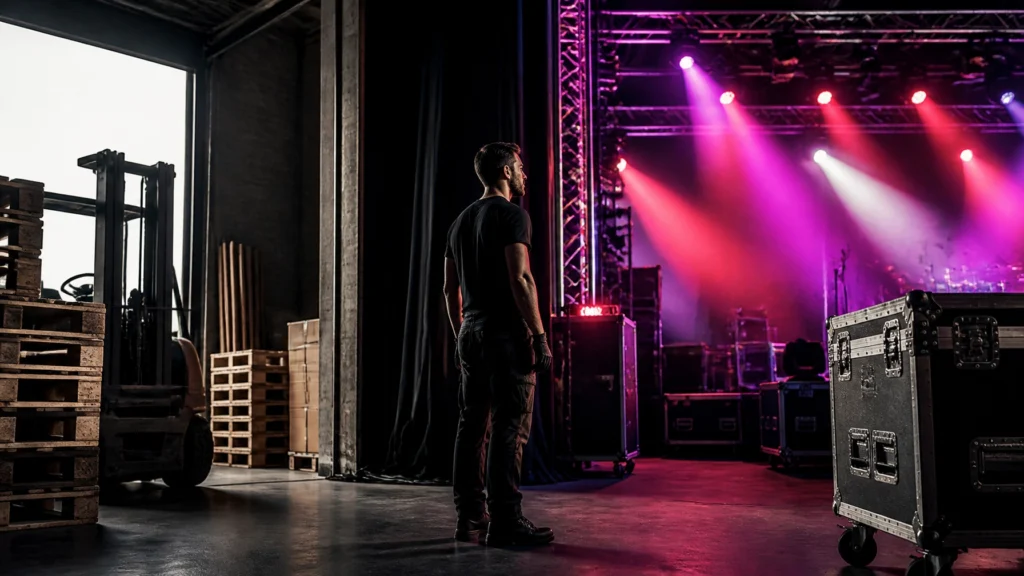
If you’ve spent any time working in a warehouse, you know the grind. You know the feeling of a heavy pallet, the hum of a forklift, and the pressure of a ticking clock. You’ve mastered the art of moving objects from point A to point B safely and efficiently.
But what if those skills could take you somewhere else? What if the heavy lifting you do every day was the foundation for a career in live events?
Transitioning from material handling to the main stage isn't as big of a leap as it seems. In fact, most of the "hard" skills you’ve learned in the warehouse are exactly what production managers are looking for. The music industry doesn't just run on talent; it runs on labor.
Here is how you can take what you already know and use it to master the basics of the live event world.
The Warehouse Foundation: Skills You Already Have
Before you worry about learning how to program a lighting console or mix a band, look at your current toolkit. You aren't starting from scratch. You are starting with a solid foundation.
Physical Stamina and Manual Handling
In a warehouse, you are on your feet for ten hours a day. You lift, carry, bend, and push. This is the "secret sauce" of a successful stagehand. Concert "load-ins" are intense. They require moving hundreds of road cases, building stages, and hanging heavy gear in a short window of time. Your ability to maintain physical energy is a massive asset.
Safety as a Second Language
Warehouses are dangerous. You’ve likely had safety training on how to lift correctly, how to navigate around moving machinery, and how to keep a workspace clean. On a stage, the stakes are even higher. There are things hanging over your head, high-voltage power lines on the floor, and tight deadlines. Your "safety-first" mindset is exactly what keeps a show from becoming a disaster.
Equipment Operation
If you can drive a forklift or operate a pallet jack, you are already ahead of 50% of the people trying to enter this industry. Big shows require massive logistics. Moving gear from the truck to the stage often involves heavy machinery. Being "certified" or even just "experienced" in material handling makes you a high-value hire for any production crew.

Translating the Skills: From Loading Dock to Load-In
When you walk onto your first gig, the environment will feel different, but the tasks will feel familiar. The key is to translate your warehouse vocabulary into "stage language."
The "Truck Pack"
In the warehouse, you load trailers. In live events, we call it the "Truck Pack." The goal is the same: fit as much as possible into the space without anything breaking. The difference is that instead of pallets, you are dealing with road cases. Understanding weight distribution and how to secure a load with straps is a skill that translates perfectly.
Staging the Gear
Just like you might "stage" outbound shipments in a warehouse, a stage crew "stages" gear in the wings. This means organizing equipment so that the audio team, lighting team, and backline tech can grab what they need without searching. Your organizational skills from inventory management will make you a hero in the eyes of a busy crew chief.
The Pallet to Stage Deck Pipeline
Building a stage is essentially building a giant, very sturdy floor. If you’ve assembled racking or moved heavy industrial shelving, you understand the mechanics of stage decks. It’s about alignment, locking mechanisms, and ensuring stability. It’s heavy work, but it’s work you already know how to do.
Learning the Technical Basics
Once you’ve mastered the heavy lifting, it’s time to add some technical tools to your belt. You don't need a degree in engineering to start; you just need to understand the basics of the "technical setup."
The Art of the Cable
If there is one thing that separates a pro from an amateur, it’s how they handle cables. In the warehouse, you might just throw a rope aside. On a stage, every cable has a specific way it must be coiled.
Most crews use the "over-under" method. This prevents the cable from twisting or kinking, which ensures it lasts longer and lays flat on the ground. Learning this one skill will immediately make you look like a veteran.

Understanding the Hardware
You’ll start seeing a lot of new gear: truss, shackles, clamps, and safety cables.
- Truss: These are the aluminum beams that hold up the lights.
- Shackles: These connect the gear to the motors.
- Safety Cables: These are the "seatbelts" for the lights.
Think of these as the industrial nuts and bolts of the stage. You don’t need to be a rigger (the person who hangs things from the ceiling) to know how to tighten a clamp or attach a safety.
Rigging Awareness
As someone coming from labor, you already know: Never stand under the load. This is the golden rule of rigging. When you hear someone yell "HEADS!" or "POINTS MOVING!", it means something is moving above you. Your warehouse experience has already trained your ears to listen for heavy machinery; now, you’re just listening for things moving in the air.

The Professional Mindset: Etiquette and Teamwork
The technical skills can be taught. The physical strength can be built. But the mindset? That’s what gets you invited back to the next show.
Be the "Yes" Person
In the live event world, things change fast. A lead might tell you to move a case to the left, and then five minutes later, tell you to move it back to the right. Don't take it personally. In the warehouse, the goal is efficiency. On a stage, the goal is the show. Be flexible. If you are asked to do something, say "Copy that" and get it done.
Stay Quiet During Soundcheck
This is a big one. In a warehouse, you might talk or listen to music while you work. On a stage, there are moments of "silence." When the band is soundchecking or when the lighting designer is "focusing," the stage becomes a quiet zone. Learning when to work hard and when to stand still is part of the professional etiquette.
Ask, Don't Guess
In the warehouse, a mistake might mean a broken pallet. On a stage, a mistake can mean a $50,000 light falling or someone getting seriously hurt. If you aren't sure how a piece of gear works, ask. The crew would much rather spend two minutes explaining it to you than two hours fixing a mistake.

How to Start the Transition Today
You don’t have to quit your warehouse job tomorrow to start this journey. Here is a simple plan to bridge the gap:
- Update Your Resume: Don't just say "Warehouse Worker." Say "Experienced in heavy material handling, equipment operation (Forklift), and safety compliance in fast-paced environments."
- Look for "Labor" Gigs: Search for "Stagehand," "Loader," or "Event Crew" in your area. These roles are specifically looking for people who are strong and reliable.
- Learn the Over-Under: Go buy a 25-foot extension cord and practice coiling it using the over-under method until you can do it with your eyes closed.
- Network on the Dock: Sometimes, the companies delivering gear to your warehouse are the very companies that need crews for events. Talk to the drivers. Ask who does their labor.
Conclusion
The transition from material handling to the main stage isn't about learning a whole new world; it’s about applying your existing strength to a new environment. The music, the lights, and the crowd are just the "product" you are helping to deliver.
You already have the stamina. You already have the safety mindset. You already know how to handle the gear. Now, it’s just time to step into the spotlight.