
Walking onto a concert stage for the first time can feel like stepping onto another planet. If you are coming from a background in construction, landscaping, or warehouse labor, you already have the "muscle" for the job. But the world of live events has its own set of unwritten rules, a specific language, and a pace that can catch you off guard.
At Get, we help people turn their hard-earned labor experience into a career in live events. To help you nail your first day, we’ve put together a list of the ten most important things you need to know before you ever set foot on the deck.
1. Arrive 15 Minutes Early
In the event world, if you are "on time," you are late.
Production schedules are tight. If a tour bus rolls in at 8:00 AM, the crew needs to be ready to unload the moment those doors open. Arriving 15 minutes early gives you time to find parking, check in with the steward or crew lead, and get your bearings. It shows that you are reliable and ready to work. First impressions are everything in this industry, and showing up late is the fastest way to make sure you don't get called back for the next show.
2. Wear the "Stagehand Uniform"
You don't need a tuxedo, but you do need to follow the dress code. The industry standard is "Show Black." This means:
- A plain black t-shirt or hoodie (no big logos or bright graphics).
- Black work pants (cargo pants or sturdy work trousers are best).
- Closed-toe shoes (preferably steel-toe boots or sturdy hiking boots with good grip).
The reason is simple: when the house lights go down and the show starts, the crew needs to be invisible. If you’re wearing a bright neon shirt and have to run out on stage to fix a microphone, the audience will see you. Stick to black, and make sure your clothes are durable enough to handle crawling on stages or lifting heavy cases.
3. Bring the Right Tools
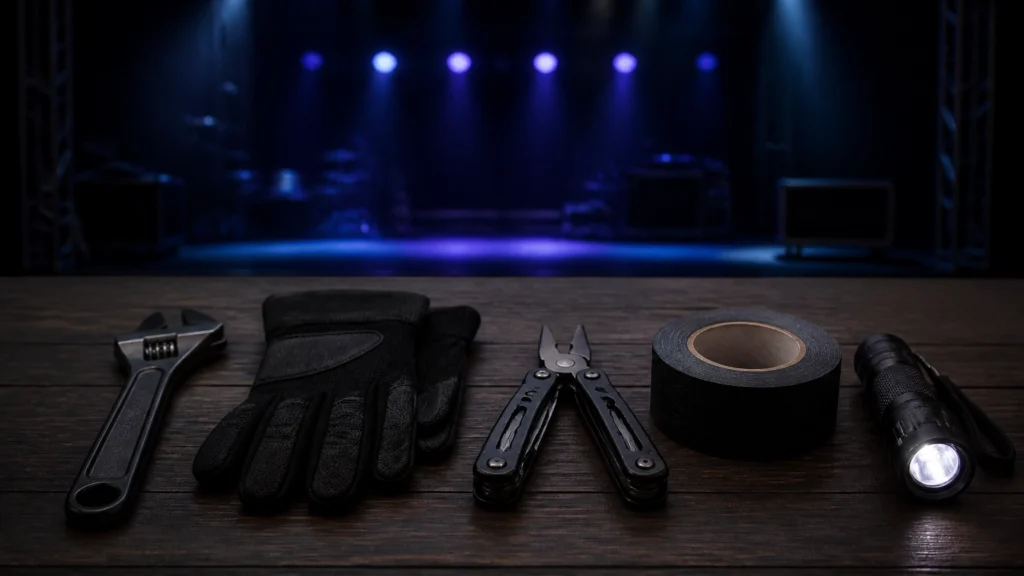
You aren't expected to have a full shop's worth of equipment on day one, but showing up with nothing makes you look like an amateur. Every stagehand should carry a small kit.

At a minimum, bring:
- An 8-inch adjustable wrench (C-wrench): This is the holy grail of stagehand tools. You’ll use it for lighting, rigging, and tightening bolts on stage sets.
- Work Gloves: You will be handling metal truss, wooden crates, and miles of cable. Protect your hands.
- A Multi-tool: Something like a Leatherman for quick fixes.
- A Sharpie: You’ll be labeling cables, tape, and road cases all day.
- A Flashlight or Headlamp: Stages are dark. You’ll need light to see into the back of a truck or under a stage.
4. Respect the Chain of Command
A concert load-in is a highly organized machine. There are different departments: Audio, Lighting, Video, Rigging, and Carpentry. Each has a lead.
Listen to your Crew Lead or Department Head. If someone from a different department asks you to do something, it is always best to check with your lead first. "My lead has me on this right now, let me check with them" is a perfectly acceptable response. This keeps the workflow organized and ensures you aren't doing a task that conflicts with your actual assignment.
5. Safety is the Priority
A stage is a dangerous environment. There are heavy objects hanging overhead, high-voltage electricity, and people moving fast.
- Look Up: If you hear someone yell "Head!" or "Heads up!", move immediately. It means something is being lowered or potentially falling.
- Never walk under a suspended load: If a truss or a speaker cluster is being hoisted into the air, stay clear of the "drop zone."
- Lift with your legs: You will be pushing "dead stacks" (heavy cases) and lifting stage decks. Don't blow out your back on the first day.
6. Don’t Touch What Isn't Yours
The gear on a tour is incredibly expensive. A single lighting console can cost as much as a luxury car. If you aren't told to touch something, leave it alone.
Never plug or unplug a cable unless you’ve been instructed to do so. This is especially true for the "Backline" department (the band's instruments). Never pick up a guitar, sit at the drum kit, or mess with an amp. It might look like fun, but to the touring crew, that gear is their livelihood.

7. Stay Off Your Phone
This is the number one complaint from crew leads about new hands. When you are on the clock, your phone should stay in your pocket.
Even if there is a lull in the action and you are "standing by," stay focused. Watch how the experienced hands are coiling cables or building the stage. Use that time to learn. If a lead sees you sitting on a road case scrolling through social media while everyone else is working, you won't be invited back.
8. Learn How to Wrap Cables (The Over-Under)
If you want to impress a touring crew, learn how to coil a cable properly. In the live event world, we use the "over-under" technique. This prevents the cable from kinking and ensures it will pull out straight the next time it’s used.
Yanking a cable out by the connector or wrapping it around your elbow (the "gardener's wrap") is a great way to get yelled at. Take five minutes to watch a tutorial on the over-under method before your first gig. It is the most used skill in the industry.
9. Maintain a Good Attitude
The work is hard. The hours are long. Sometimes you’ll be pushing cases in the rain or loading a truck at 2:00 AM.
Crews want to work with people who are positive and calm. If you are easy to talk to and willing to jump in wherever you’re needed, you will make friends quickly. The live event industry is a small world: reputations travel fast. Be the person everyone wants on their crew.
10. Learn the Language
You’ll hear a lot of terms that might sound like gibberish at first. Here are a few basics to get you started:
- FOH (Front of House): The area in the middle of the audience where the sound and light boards are located.
- Deck: The actual stage surface.
- Stage Left / Stage Right: These are from the perspective of a performer standing on stage looking at the audience. (So, Stage Left is the audience's right).
- Upstage / Downstage: Upstage is toward the back wall; Downstage is toward the audience.
- Load-in / Strike: Load-in is setting up the show. Strike (or Load-out) is taking it all down and putting it back in the trucks.

Ready for Your First Call?
Your first gig is a learning experience. No one expects you to be an expert on day one, but they do expect you to be prepared, safe, and willing to work. If you follow these ten tips, you’ll be well on your way to a successful career in live events.
If you are looking to make the jump from general labor to the big stage, Get is here to help you bridge that gap. We turn your experience into a career.